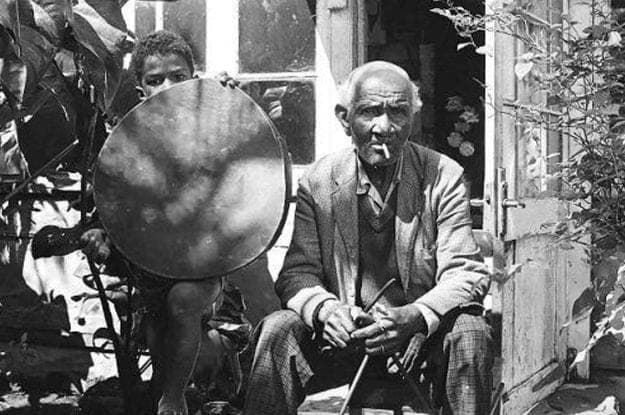
Begin with Roseda and a documented recording
Roseda is a useful first selection because it appears among the items in the CREM-CNRS catalogue for Hommage à Ti Frère. The collection contains nineteen components and documents a field recording made in Mauritius in 1989 by Rémi Gouriou. J. M. G. Le Clézio and Lucien Putz are credited for contributions to the booklet. These names connect the listening encounter to a specific recording project and its documentation.
Ocora Radio France’s later edition carries the reference C 561019. Use the artist profile to reach the credited recording, then listen to Roseda once as a whole before returning to a passage that catches your attention. The archival description gives a starting point for exploring the repertoire; it does not prescribe how you should respond to the voice.
Follow the album from 1989 to its later editions
Three dates clarify this album’s history. CREM-CNRS records a field recording in Mauritius in 1989 and an Ocora publication in 1991. Radio France’s announcement of 11 February 2026 documents a later edition. The 2026 date therefore belongs to the circulation of existing recordings, rather than to a new performance by Ti Frère.
Le Mauricien’s account of the project describes how reporting about Ti Frère and an appeal by Lucien Putz helped bring an Ocora team to Mauritius. Recording was part of preserving and circulating a repertoire. The album is valuable both as music to hear and as evidence of the people who worked to document that music.
A separate Phonothèque Historique de l’Océan Indien record credits Ti Frère and Marlène Ravaton with their ensembles and includes Ti Pierre Ti Paul. Following those credits broadens the picture beyond one famous singer. It brings other performers and ensemble relationships back into a repertoire that can lose its context when individual tracks circulate online.
Follow the voice at close range
For the next pass, concentrate on vocal delivery rather than trying to account for every sound. Listen for how a phrase begins and ends, where you hear a pause, and whether an emphasis catches your attention. These are listening prompts, not claims about a particular track. Choose one audible detail and locate it precisely enough to revisit.
Then replay the passage with the percussion back in your attention. Does your chosen vocal moment stand out differently when you hear the surrounding sound? Notice whether your attention follows the voice continuously or moves between layers. If other voices are audible, consider their relationship to the lead without assuming that every selection uses the same vocal arrangement.
Write an observation before an interpretation. Describe the delivery you noticed, then record the feeling it suggested to you. Keeping those entries separate makes your response more useful on a later listen.
Use three instruments as reference points
The National Heritage Fund’s sega tipik inventory provides concrete instrument descriptions. The ravann is a frame percussion instrument supported by the player’s body. The maravann is a rectangular shaker containing seeds. The triyang is a bent metal rod sounded with a beater. These descriptions offer a practical starting point for distinguishing a drum sound, a shaken texture and a struck metal sound.
Use those contrasting sound-producing actions to guide separate listening passes. First follow a percussion layer you can recognise confidently. Next, attend to a different layer and consider how it changes your perception of the voice. You are listening for relationships between sounds, not reconstructing a prescribed rhythm or treating the inventory as a personnel list for the album.
Try following one layer throughout your chosen passage, then replay it while listening to the whole texture. Notice what becomes easier to hear in isolation and what makes more sense in combination. Construction and playing styles can vary, so use the instrument descriptions as reference points rather than rigid specifications.
Separate storytelling from your first impression
Storytelling invites attention to both delivery and words, but those kinds of understanding need not arrive together. Keep two columns in your notes: what you can hear in the performance and what you understand of the verbal meaning. A strong emotional impression belongs in your response to the delivery; a claim about a character, event or subject needs support from the words.
If you understand the sung language, return to a passage whose meaning you can follow and consider how its delivery shapes your attention. If you do not, you can still track phrase boundaries, pauses and shifts of emphasis without assigning a plot. With a reliable explanation available, listen again and compare it with your earlier impression. The useful question is not whether your first feeling was wrong, but what understanding the words adds or changes.
Read memory and exile as a listening frame
Ocora’s presentation puts voice, memory and the experience of exile at the centre of the encounter with this repertoire. That framing is worth reading alongside the recording. It directs attention towards expressive presence and remembrance, rather than offering only an album identifier. It is also the label’s presentation of the release, not a statement made during an original recording session.
Try two passes through your chosen passage: one before revisiting that framing, and one afterwards. Ask which details attract your attention on each pass. A theme supplied by accompanying prose can change how you listen, but it does not by itself establish the subject of every song. Keep the label’s account, the audible performance and your own associations as distinct entries. Together they can enrich the encounter without turning a personal response into a historical claim.
Build a small record of repeated listening
Bring the exercise together on one page. Record the release title, catalogue reference, edition date, track title and passage location. Add one observation about the voice, one about a confidently identified percussion layer, and one question about meaning. This creates a compact record you can actually use when returning to the music.
Now choose another track from the same release and repeat the same questions. Compare your observations rather than trying to rank the performances. Did a different detail draw your attention? Did the label’s framing prove more useful on one selection than another? These questions leave room for differences within a repertoire instead of turning one passage into a formula.
Ti Frère is a central reference for the expressive voice of sega tipik, not a substitute for every performer or community. After this focused exercise, another named singer provides a useful comparison. Carry forward the method and the source details, rather than expecting the next recording to reproduce your first encounter.
Common questions
Which Ti Frère release should I use for this exercise?
Use Ocora’s Île Maurice, Hommage à Ti Frère. Séga, musique de l’exil, reference C 561019. Radio France’s February 2026 announcement provides a documented catalogue entry. Choose one track before attempting a comparison across the release.
Were these performances recorded in 2026?
No. CREM-CNRS documents a field recording in Mauritius in 1989 and an Ocora publication in 1991. Radio France’s February 2026 announcement concerns a later edition. Keep those three dates attached to their different roles when exploring the album.
Can I use this method without understanding the words?
Yes. Begin with delivery, phrase boundaries and the relationship between voice and percussion. Record your emotional response separately from claims about verbal meaning. A reliable explanation of the words can support a later, more informed listening pass.
Which percussion instruments provide useful reference points?
The National Heritage Fund describes the ravann, a body-supported frame percussion instrument; the maravann, a seed-filled rectangular shaker; and the triyang, a bent metal rod struck with a beater. Use their contrasting actions to guide attention, not to assume every track’s instrumentation.
Sources and further reading
Île Maurice, Hommage à Ti Frère. Séga, musique de l’exil Ocora Radio France
Sega Tipik Morisien inventory entry National Heritage Fund, Mauritius
Île Maurice, hommage à Ti Frère, collection record CREM-CNRS
Archives. La mémoire, monwar ! Le Mauricien
Séga Mauricien, Ti Frère et Marlène Ravaton et leurs ensembles Phonothèque Historique de l’Océan Indien