Read the outfit through the setting
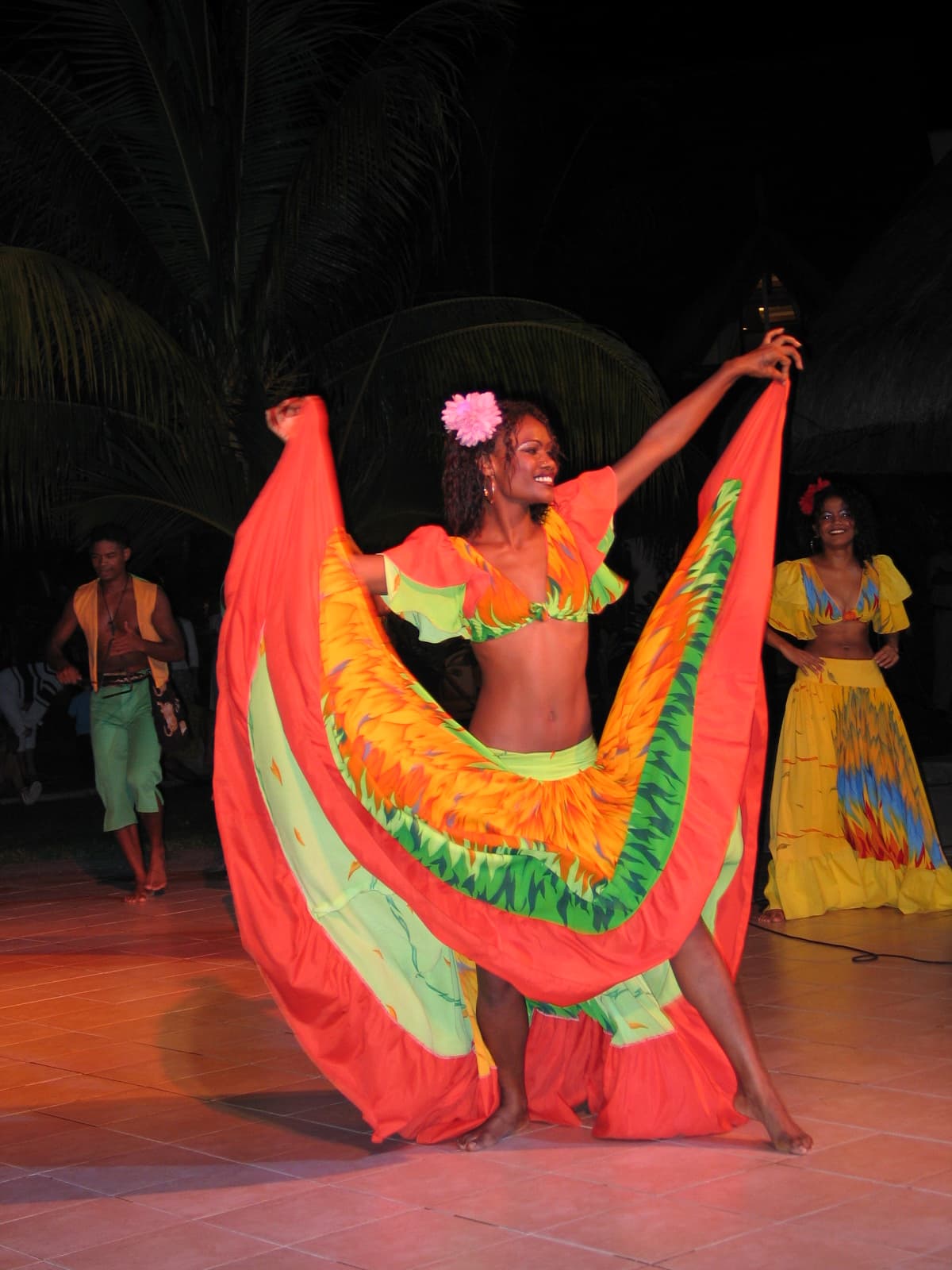
In the contemporary performance clothing discussed by researchers Laura Jeffery and Rebecca Rotter, Mauritian women’s outfits combine a cropped top with a long, flared skirt. The fullness gives fabric room to move as the dancer turns. Their study contrasts this with Chagossian women’s descriptions of tops covering the midriff and skirts worn with an underskirt and slip. These observations help identify differences between particular performance traditions, while leaving room for the choices of individual groups.
Begin with the occasion. Is this a hotel performance, a teaching session, a family gathering or a presentation representing Mauritius abroad? Églantine Gauthier’s research distinguishes family practice, hotel troupes and cultural representation overseas. Her analysis shows sega’s development as a national dance through change and circulation, rather than as an unchanged performance transferred from one setting to another.
That distinction offers a useful way to observe clothing. Compare the outfits within the particular presentation: do performers coordinate their appearance, wear different garments or change clothing between parts of the programme? These are questions to investigate, not features to expect everywhere. Ask the group how it describes its presentation. A staged outfit can be considered as part of professional performance without either dismissing it as inauthentic or making it the standard for every sega gathering.
A contemporary skirt is not a historical timeline
A full skirt seen in a contemporary show tells you about that presentation. It does not, by itself, establish what people wore in another century or in a different social setting. Gauthier’s account complicates a simple progression from slavery to tourism. Clothing should be approached with the same attention to change, rather than used to illustrate an uninterrupted, identical tradition.
Historical context matters beyond the garment. Laura Jeffery and Rebecca Rotter situate sega within the colonial Indian Ocean and encounters among enslaved people with different ancestral backgrounds. For a historical costume claim, ask for a dated example and its context: who wore the clothing, where and for what occasion? A photograph or description tied to one event should remain evidence of that event, not become a wardrobe rule for an entire history.
Watch the fabric without losing the performance
Try a simple observation exercise. Watch the outline of a garment, then shift attention to the dancer’s body and the space around them. Notice whether fabric follows a movement, obscures it or draws your eye towards it. Describe what you actually see rather than assigning a fixed meaning to a colour, shape or gesture.
Then bring the musicians back into view. For sega tipik, the National Heritage Fund documents the ravann as a body-supported frame percussion instrument, the maravann as a rectangular seed-filled shaker and the triyang as a bent metal rod sounded with a beater. Those instruments offer concrete points of attention beyond the costume.
Move your attention between clothing, movement and the people making the music. This is a way to observe a performance, not a lesson in prescribed steps. If garment handling interests you, ask a teacher to explain it within that particular presentation.
Let performers explain what their clothing means
Separate three questions: what is the garment, why was it chosen for this presentation, and what does it mean to the people wearing it? Appearance alone cannot answer all three. Gauthier’s research examines cultural representation and the changing public place of sega. That makes the performers’ own description more useful than an outside assumption that every visible feature has one national meaning.
Community context also deserves precision. Jeffery and Rotter’s study of Chagossian sega examines relationships between safeguarding, transmission, state narratives and community claims. Their analysis cautions against allowing a broad national account to obscure a smaller community’s experience. When discussing an outfit, keep the group’s stated tradition attached to it. A useful question is, “How does this clothing relate to your presentation?” rather than asking performers to explain a supposedly universal sega costume.
Choose visitor clothing for comfort and the activity
For watching, a practical starting point is an ordinary top with trousers, shorts or a skirt that lets you sit and move comfortably, subject to the venue’s requirements. There is no reason to build a costume purchase into your preparation. Check any event-specific clothing guidance directly with the organiser.
If you may join a session, test your outfit by walking, turning and bending gently before leaving. Choose a hem you will not step on and secure loose accessories that could catch or distract you. These are comfort and movement suggestions, not a definition of traditional sega dress.
Ask the teacher about footwear for the actual floor rather than assuming you should remove your shoes or copy a stage performer’s footwear. Mention relevant mobility needs and request alternatives for uncomfortable movements. Preparing to participate means choosing clothes that work for you and following the session’s guidance, not reproducing someone else’s stage appearance.
Borrowing a costume needs its own conversation
An invitation to dance is not the same as an offer to lend clothing. If a teacher or performer offers a garment, ask what the activity involves: a demonstration, participation in a session or a photograph. Establish who will help with fitting and whether the item can comfortably accommodate the movements you are being asked to make.
Before accepting it, clarify fastening, handling and return arrangements. Ask how to hold or adjust any unfamiliar part rather than pulling at it experimentally. If the fit feels awkward, request another option or continue in your own clothes. Keep the garment and photography conversations separate: borrowing an outfit does not settle whether other people wish to appear in photographs or have those images shared.
Buy for a clear purpose rather than a promise of authenticity
If you decide to look for a garment, identify its intended use first. A keepsake, an outfit for your own learning and clothing requested for a particular performance are different purchases. For participation, consult the teacher before choosing. For a keepsake, concentrate on what you can establish about the item rather than expecting it to represent the whole tradition.
Useful questions include who made it, what fabric it uses, how it should be washed, whether alterations are possible and what the seller means by calling it a sega costume. If a historical or community-specific claim matters to your decision, ask for its basis. Record the maker’s description accurately. Owning a garment can preserve a connection to a particular encounter, but it does not confer dance skill or authority to represent a community.
Common questions
Do visitors need to buy a sega costume?
Do not treat a costume purchase as necessary preparation. Comfortable everyday clothing is a sensible starting point, with any venue or teacher requirements checked separately. If a session includes trying a garment, ask what is provided and whether participation in that part is optional.
Does a full skirt prove that a performance is historically authentic?
No. An outfit identifies an aspect of the presentation you are seeing, not its entire historical lineage. Gauthier’s research describes changing settings and forms of cultural representation. A claim about clothing in a particular period needs evidence tied to that period and context.
Should I take off my shoes before joining a sega session?
Ask the teacher or organiser about the floor and the session’s footwear guidance. Do not infer a requirement from what a stage performer wears. If the suggested option is uncomfortable or unsuitable for your mobility needs, ask for an alternative before joining.
What should I ask before photographing someone in costume?
Ask whether the person is comfortable being photographed, and separately whether you may share the image. An invitation to dance or borrow clothing does not answer those questions. Where correct performer credits are available, use them rather than describing people only through their costumes.
Sources and further reading
Du séga créole à la danse nationale. Recompositions locales et circulations transnationales mauriciennes Églantine Gauthier, Revue européenne des migrations internationales
Safeguarding sega: transmission, inscription, and appropriation of Chagossian intangible cultural heritage Laura Jeffery and Rebecca Rotter, International Journal of Heritage Studies
Sega Tipik Morisien inventory entry National Heritage Fund, Mauritius