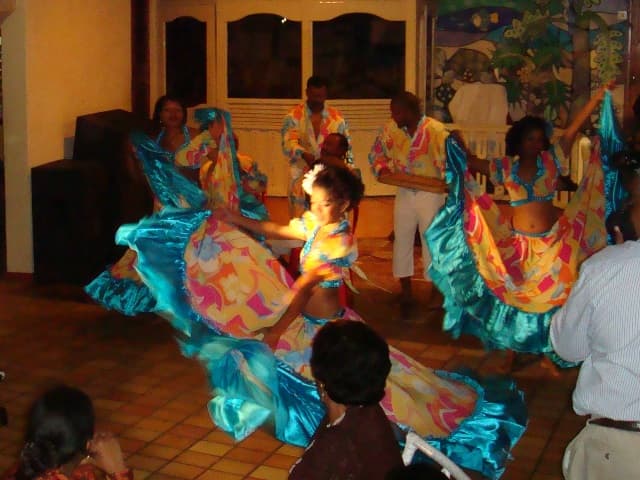
Begin with the music and the people
Traditional Mauritian sega brings together singing, dance, instrumental performance and instrument making. UNESCO’s 2014 inscription decision describes a practice rooted in the Creole community and shared more widely in Mauritius. Dance belongs within that connected practice, rather than being an isolated sequence to collect.
The same decision identifies participation and apprenticeship as ways knowledge is passed on. For a beginner, this makes the person guiding you and the musicians part of the lesson. Watching, listening and trying a movement are connected activities, not competing ways to spend the session.
If you arrived looking for sega dance steps, use that interest as a starting point. Aim first to understand the task being demonstrated and its relationship to the music. A manageable first goal is to take part attentively, rather than complete an entire routine.
Give your observation a clear purpose
Begin by identifying the setting. A staged performance, a teaching session and a social gathering call for different approaches. At a performance, remain in the audience area while watching. In a class, give your attention to the teacher’s introduction and demonstration before deciding what to copy.
Try a simple observation exercise. First notice the space dancers occupy and how they enter or leave it. Then shift your attention to the relationship between their movement and the musicians. This gives you something specific to watch without requiring you to identify a rhythm or name a step.
When a teacher demonstrates, notice both the movement and the room it uses. Choose a viewing position where you can see without blocking another learner. This prepares you to follow the task while remaining aware of the people nearby.
Enter on an invitation and keep room around you
Wait for a clear invitation from the teacher, performers or person guiding participation. Applause or other spectators standing up is not a useful substitute. When invited, you can accept, continue watching or join later if the setting allows. Enthusiasm does not need to mean immediate participation.
Once you enter, begin in the place indicated rather than choosing the most prominent position. Leave enough room to move without crowding someone else or obstructing the musicians. As a practical starting point, keep your movements modest while you understand the space and the task.
Treat shared space and physical contact as separate choices. An invitation to dance is not automatically an invitation to take someone’s hand or move close to them. Follow any grouping the teacher explains, and check with the other person before initiating contact.
Let the teacher set the first task
In a teaching session, concentrate on the demonstration in front of you rather than combining it with movements remembered from a video or another event. Follow the order the teacher gives. If several elements are demonstrated together, ask which one a beginner should concentrate on first.
Make requests specific enough to help the teacher respond. You might ask to see the movement again, ask where to stand or explain which part you lost. A repeated demonstration can be more useful than trying to turn an unfamiliar movement into a long verbal description.
If you lose track, pause and watch the next demonstration instead of rushing to catch up. Rejoin at the point the teacher indicates. This is a practical way to approach participation-based learning, not a claim that every sega teacher uses the same method or sequence.
Listen for three contrasting instruments
The National Heritage Fund describes the ravann as a frame percussion instrument supported by the player’s body. It identifies the maravann as a rectangular shaker filled with seeds, and the triyang as a bent metal rod sounded with a beater. These are three central instruments of sega tipik.
Their construction gives a beginner concrete listening anchors. Frame percussion, seeds moving inside a shaker and metal sounded by a beater offer different contributions to the combined sound. As a listening exercise, try distinguishing one instrument, then another, before returning your attention to the ensemble.
Bring that attention back to the dancer or teacher. Observe how movement relates to what you hear, without assigning a compulsory step to each instrument. UNESCO’s description connects movement and percussion; your first encounter can begin with noticing that relationship rather than attempting a technical musical analysis.
Adapt the task to your comfort
Before a lesson begins, explain any movement limitations relevant to the activity and check the teacher’s footwear guidance. Keep the conversation practical by describing what you would prefer to avoid or adapt. This gives the teacher a clearer starting point than a general question about whether the class suits everyone.
During participation, work within a comfortable range rather than matching another dancer’s largest movement. If something feels uncomfortable, stop that movement and request an alternative. You can also rest or return to observing; participation need not mean copying every demonstrated element.
Keep your own learning goal small and observable. You might focus on following one instruction, maintaining room around you or hearing an instrument while watching the demonstration. These are suggested beginner goals, not formal standards of achievement. Choose one that lets you remain attentive without feeling pressured to perform for spectators.
Use a documented route into further learning
ABAIM describes its ravann school as growing from a school established in Mauritius in 1986. The organisation is based in Beau Bassin and documents teaching adults and children. It also states that foreigners have learned through its pedagogical approach, making this a concrete visitor-learning enquiry route.
Its relevance here is the musical side of participation. Someone who becomes curious about the instruments while dancing has a documented organisation to approach about ravann learning. Treat this as a music-learning lead rather than an advertised beginner dance class.
Use the contact details on ABAIM’s ravann school page for an enquiry. State that you are a beginner and explain your interest. Before travelling, confirm the teaching language, level, equipment requirements, session availability and fees. If your main aim is dance instruction, make that distinction clear in the enquiry.
Common questions
Do I need to memorise sega dance steps before joining?
You can prepare by watching and listening rather than memorising a routine. In a class, identify yourself as a beginner and follow the teacher’s first task. UNESCO describes learning through participation and apprenticeship, which places learning with practitioners at the centre of the process.
Does an invitation mean I have to dance with a partner?
Treat an invitation as a chance to participate, not an obligation to pair up or accept physical contact. Follow the teacher’s arrangement and explain if you prefer to participate independently. Check with another person before taking their hand or moving into their space.
What should I do if a movement feels uncomfortable?
Stop that movement, rest or return to observing. If you want to continue, explain the difficulty and request a simpler or different task. You do not need to match another participant’s range of movement. Mention relevant limitations before a lesson so adaptations can be discussed early.
Is ABAIM a learning contact for visitors?
Yes. ABAIM’s ravann school documents teaching adults and children, including foreigners who have learned through its approach. It is a music-learning enquiry route in Beau Bassin, not a confirmed dance-class booking. Contact the organisation to establish the language, level, equipment, fees and available sessions.
Sources and further reading
Traditional Mauritian Sega, decision 9.COM 10.28 UNESCO
Sega Tipik Morisien inventory entry National Heritage Fund, Mauritius
The ravann School ABAIM